Everest Base Camp Trek – 14 Days
Trip Facts
Country:
Nepal
Duration:
14 Days
Max Altitude:
5,555 m / 18,225 ft
Activities:
Trekking
Region:
Everest Region
Start / End:
Kathmandu / Kathmandu
Transportation:
Flights to Lukla, tourist buses and shared jeeps
Grade:
Moderate to Strenuous
Group Size:
Min 2
Accomodation:
Hotel and teahouse lodges
Trips Overview
The Everest Base Camp Trek is Nepal’s most famous trek, taking you to the foot of Mount Everest (8,848.86 m / 29,032 ft), the world’s highest mountain. This 14-day journey begins with a thrilling mountain flight to Lukla, then follows the Dudh Koshi valley deep into the Khumbu region. Along the way, you cross high suspension bridges, pass prayer-flag-draped mani walls and walk through Sherpa villages framed by snow peaks.
The trail climbs through Sagarmatha National Park, a UNESCO World Heritage Site, to Namche Bazaar, the lively Sherpa trading town, and on to Tengboche Monastery, the largest monastery in the Khumbu. Higher up, you trek through Dingboche and Lobuche to reach Everest Base Camp (5,364 m) beside the Khumbu Glacier and Icefall. The next morning, a sunrise hike to Kala Patthar (5,555 m) gives you the trek’s best close-up views of Everest, Nuptse, Lhotse and Pumori.
Our itinerary is built around safe acclimatization. Two acclimatization days, in Namche Bazaar and Dingboche, follow the “climb high, sleep low” principle, so your body adjusts gradually to the thin air. No climbing experience is needed: if you are healthy and can walk 5–7 hours a day on hilly trails, you can complete this trek with good preparation.
We take care of the logistics: Lukla flights, trekking permits, an experienced licensed guide, porters, teahouse lodging and meals on the trail, and your hotel in Kathmandu. Trek in spring (March–May) or autumn (late September–November) for the clearest skies and most stable weather.
Trip at a Glance
The trek takes 14 days from Kathmandu, with 11 days on the trail and a high point of 5,555 m at Kala Patthar.
| Duration | 14 days (11 trekking days) |
|---|---|
| Start and end | Kathmandu; the trek starts and ends in Lukla |
| Highest point | Kala Patthar, 5,555 m / 18,225 ft |
| Everest Base Camp | 5,364 m / 17,598 ft |
| Difficulty | Moderate to strenuous; no technical climbing |
| Walking per day | 3–8 hours (5–7 hours on most days) |
| Trek distance | About 120–130 km (75–80 miles) round trip from Lukla, including side hikes |
| Acclimatization days | 2: Namche Bazaar (Day 4) and Dingboche (Day 7) |
| Best seasons | Spring (March–May) and autumn (late September–November) |
| Accommodation | Hotel in Kathmandu; teahouse lodges on the trek |
| Meals | Breakfast in Kathmandu; breakfast, lunch and dinner on the trek |
| Transport | Flights to and from Lukla (from Kathmandu or Manthali, Ramechhap); tourist bus or shared jeep between Kathmandu and Manthali |
| Permits | Sagarmatha National Park entry permit; Khumbu Pasang Lhamu Rural Municipality permit |
Trips Highlights
- Fly into Tenzing-Hillary Airport in Lukla, one of the world's most thrilling mountain airstrips
- Cross the Hillary Suspension Bridge, strung high above the Dudh Koshi gorge on the way to Namche
- Explore Namche Bazaar, the Sherpa capital, with its bakeries, gear shops, Saturday market and Sherpa Culture Museum
- Sip tea facing Everest, Lhotse and Ama Dablam at Hotel Everest View (3,880 m), one of the world's highest-placed hotels
- Visit Khumjung village, home to the school founded by Sir Edmund Hillary and a monastery said to keep a yeti scalp
- Hear the monks chant at Tengboche Monastery (3,860 m), the largest monastery in the Khumbu and home of the Mani Rimdu festival
- Pass Pangboche, home to one of the oldest monasteries in the Khumbu, beneath the soaring spire of Ama Dablam
- Climb Nangkartshang Peak (5,083 m) for views of Makalu (8,485 m), the world's fifth-highest mountain
- Pay your respects at the climbers' memorials on the Thukla Pass (4,830 m)
- Stand at Everest Base Camp (5,364 m) beside the Khumbu Icefall and Glacier
- Watch the sun rise over Mount Everest from Kala Patthar (5,555 m), the trek's highest and best viewpoint
- Spot Himalayan tahr, musk deer and the Danphe (Himalayan monal), Nepal's national bird, in Sagarmatha National Park
- Sleep in family-run Sherpa teahouses and pass prayer wheels, chortens and mani walls all along the trail
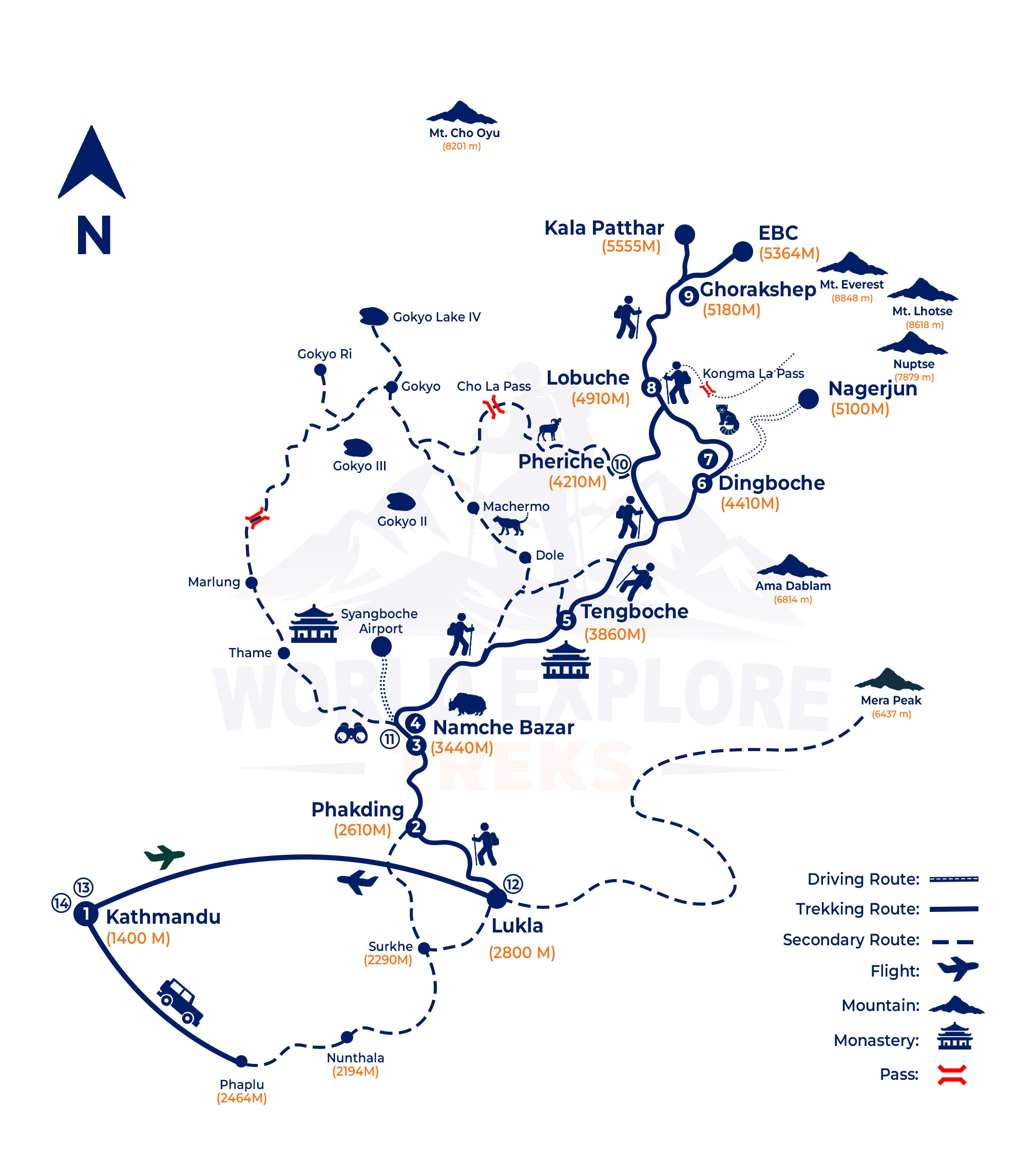
Route: Kathmandu → Lukla → Phakding → Namche Bazaar → Tengboche → Dingboche → Lobuche → Gorak Shep → Everest Base Camp → Kala Patthar → Pheriche → Namche Bazaar → Lukla → Kathmandu
The route climbs gradually from Lukla (2,840 m) to Kala Patthar (5,555 m) by Day 10, with acclimatization stops in Namche and Dingboche, then descends to Lukla by Day 12. Walking times are for an average trekker and include short rest stops.
Days 4 and 7 are the “climb high, sleep low” acclimatization days: you hike well above camp, then return to sleep lower.
Trips Itinerary
Welcome to Nepal! Our representative meets you at Tribhuvan International Airport and drives you to your hotel. After checking in, take a few hours to rest. Kathmandu sits at about 1,400 m, so this is a gentle first step up in height.
Later in the day you meet your trekking guide for a briefing on the route, safety at altitude and the next morning’s flight. Bring your gear: your guide will look at your boots, layers and sleeping kit, and anything missing can be bought or rented in Thamel, Kathmandu’s trekking district.
Please plan to arrive by early afternoon. When the Lukla flight leaves from Manthali in Ramechhap, the shared jeep or tourist bus sets off in the small hours, often around 1–2 AM.
Duration:
20–30 minute airport transfer
Accommodation:
Hotel in Kathmandu
Max Altitude:
1,400 m / 4,593 ft (Kathmandu)
The day starts with one of the most famous flights in the world. Tenzing-Hillary Airport in Lukla has a runway just 527 m long that slopes uphill at 11.7%, with high ground at one end and a steep drop into the valley at the other. Edmund Hillary had it built in 1964, and it was renamed after him and Tenzing Norgay in 2008.
In spring and autumn, Lukla flights usually leave from Manthali Airport in Ramechhap to ease congestion in Kathmandu, so you travel there by shared jeep or tourist bus before dawn. In the quieter months, flights normally go straight from Kathmandu.
In Lukla you meet your porters and start walking. The trail descends gently through Chheplung to the Dudh Koshi River, past mani stones, prayer wheels and views of Khumbila, the sacred mountain of the Khumbu. This short first day helps your body adjust before a relaxed evening in Phakding.
Duration:
3–4 hours (about 8 km)
Accommodation:
Teahouse in Phakding
Max Altitude:
2,840 m / 9,318 ft (Lukla)
Meals:
Breakfast, lunch, dinner
Today you follow the Dudh Koshi upstream through pine forest, crossing it several times on long suspension bridges strung with prayer flags. At Monjo you enter Sagarmatha National Park, set up in 1976 and listed as a UNESCO World Heritage Site in 1979, and your permits are checked at the gate.
After lunch near Jorsalle, the trail crosses the high Hillary Suspension Bridge over the gorge and starts the hardest climb so far: two to three hours of steady uphill to Namche Bazaar. On a clear day, stop at the Top Danda viewpoint for your first glimpse of Everest.
Namche, at 3,440 m, is the main trading town of the Khumbu, built in a horseshoe-shaped bowl between Kongde Ri (6,187 m) to the west and Thamserku (6,623 m) to the east. Its lanes are full of lodges, gear shops and bakeries, and it’s your home for the next two nights.
Duration:
6–7 hours (about 11 km)
Accommodation:
Teahouse in Namche Bazaar
Max Altitude:
3,440 m / 11,286 ft (Namche Bazaar)
Meals:
Breakfast, lunch, dinner
A second night in Namche gives your body time to adjust, but you stay active. In the morning you climb above the town past the Syangboche airstrip to Hotel Everest View (3,880 m). Over a hot drink on its terrace, look out at Everest, Lhotse, Ama Dablam and Thamserku.
If you feel strong, carry on to Khumjung (3,790 m), below the sacred peak of Khumbila. Edmund Hillary’s Himalayan Trust built the village school here in 1961, and the monastery keeps what is said to be a yeti scalp.
Back in Namche, spend the afternoon resting or browsing the shops. On Saturdays there’s a weekly market in the centre of town, and traders sell Tibetan goods in the lanes every day.
Duration:
3–4 hours round trip
Accommodation:
Teahouse in Namche Bazaar
Max Altitude:
3,880 m / 12,730 ft (Hotel Everest View)
Meals:
Breakfast, lunch, dinner
A balcony trail contours high above the Dudh Koshi, with Everest, Lhotse and Ama Dablam ahead for much of the morning. Look out for Himalayan tahr on the slopes, and for the danphe, Nepal’s colourful national bird. Past Kyangjuma, the path drops to Phunki Tenga for lunch beside the river.
From the river, a steady climb of about two hours through rhododendron and pine leads to Tengboche (3,867 m), home to the largest monastery in the Khumbu. Lama Gulu founded it in 1916; it was destroyed by the 1934 earthquake, rebuilt, burned down in 1989 and rebuilt again, with the new building consecrated in 1993.
If you arrive in time, join the monks’ afternoon prayers. In October or November, the monastery may be holding Mani Rimdu, a masked dance festival whose dates follow the Tibetan lunar calendar.
Duration:
5–6 hours (about 10 km)
Accommodation:
Teahouse in Tengboche (or nearby Deboche)
Max Altitude:
3,860 m / 12,664 ft (Tengboche)
Meals:
Breakfast, lunch, dinner
Descend through mossy rhododendron forest to Deboche, cross the Imja Khola and climb gently to Pangboche (3,985 m). Its old monastery is famous for a purported yeti scalp and hand, though the hand was stolen years ago, and the village is the base for climbers heading to Ama Dablam, which towers right above it.
Beyond Pangboche the trees give way to juniper and low scrub. After lunch in Somare, the valley opens out to Dingboche at 4,410 m, a village of stone-walled fields where potatoes and barley grow in the short summer. Island Peak (Imja Tse) and the huge wall of Lhotse rise above it.
You’re now above 4,000 m, and most people feel it: a light headache, short breath on small climbs and broken sleep are all normal. Walk slowly, drink plenty and let your guide set the pace.
Duration:
5–6 hours (about 11 km)
Accommodation:
Teahouse in Dingboche
Max Altitude:
4,410 m / 14,469 ft (Dingboche)
Meals:
Breakfast, lunch, dinner
Your second acclimatization day follows the “climb high, sleep low” rule. After breakfast, hike up the ridge behind Dingboche to the Nangkartshang viewpoint at 5,083 m, on a steady, rocky path with no technical sections.
From the top you look out to Makalu (8,485 m), the world’s fifth-highest mountain, plus Lhotse, Ama Dablam, Island Peak and the glaciers of the Imja valley. Take your time; at this height the air holds only a little more than half the oxygen it does at sea level.
Return to Dingboche for lunch and a lazy afternoon. A short stroll, plenty of fluids and an early night get you ready for the higher ground ahead.
Duration:
4–5 hours round trip
Accommodation:
Teahouse in Dingboche
Max Altitude:
5,083 m / 16,677 ft (Nangkartshang Peak)
Meals:
Breakfast, lunch, dinner
The trail climbs gently across open yak pastures above the Pheriche valley to Thukla (Dughla) for lunch. Next comes a steep climb up the end of the Khumbu Glacier’s moraine to the Thukla Pass (4,830 m). Here, dozens of stone memorials and prayer flags honour climbers and Sherpas who died on Everest. It’s worth stopping for a few quiet minutes.
From the pass the gradient eases, and the path follows the edge of the glacier to Lobuche (4,910 m), a small group of lodges below Lobuche Peak. Pumori and Nuptse rise ahead.
Tonight is noticeably colder than Dingboche. Wear your down jacket at dinner and keep your water bottle inside your sleeping bag so it doesn’t freeze.
Duration:
5–6 hours (about 8 km)
Accommodation:
Teahouse in Lobuche
Max Altitude:
4,910 m / 16,109 ft (Lobuche)
Meals:
Breakfast, lunch, dinner
Today you reach your goal. A rocky trail along the side of the Khumbu Glacier brings you to Gorak Shep (5,164 m) in 2–3 hours. The name means “dead ravens”, a nod to how little grows here, and the lodges sit beside a sandy, frozen lakebed. The Swiss expedition of 1952 used this spot as its base camp.
After lunch and a rest, walk on for about two hours over boulders and glacial rubble to Everest Base Camp (5,364 m), beside the Khumbu Icefall. Everest’s summit is hidden behind its own ridges from here, but you stand right below the jumbled ice towers of the Icefall, with Nuptse, Khumbutse and Lingtren all around. In spring, the camp fills with colourful expedition tents.
Walk back to Gorak Shep for the night. It’s the highest you’ll sleep, and the coldest.
Duration:
7–8 hours (about 12–13 km)
Accommodation:
Teahouse in Gorak Shep
Max Altitude:
5,364 m / 17,598 ft (Everest Base Camp)
Meals:
Breakfast, lunch, dinner
Rise before dawn and climb Kala Patthar by headlamp, a 1.5–2 hour ascent in sub-zero cold over a steep, sandy trail. From the top, the sun comes up behind Everest, with Nuptse, Lhotse, Pumori, Changtse and the Khumbu Icefall laid out around you. It’s the trek’s highest point and the best close-up view of the world’s highest mountain.
Back at Gorak Shep for breakfast, you retrace your steps past Lobuche and over the Thukla Pass, then branch off down to Pheriche. The Himalayan Rescue Association’s small hospital here, built with Japanese support in 1975, is staffed by Nepali and volunteer foreign doctors during the main seasons.
After more than 1,300 m of descent, the thicker air makes a real difference, and most people sleep much better tonight.
Duration:
7–8 hours (about 14 km)
Accommodation:
Teahouse in Pheriche
Max Altitude:
5,555 m / 18,225 ft (Kala Patthar)
Meals:
Breakfast, lunch, dinner
A long, easy-on-the-lungs day back down the valley. The trail passes through Pangboche and the forests below Tengboche, with views you may have missed on the way up because you were looking at your feet.
After a short climb back to Tengboche and a drop to Phunki Tenga, a final uphill stretch leads around the hillside to Namche Bazaar. It’s 7–8 hours of walking in all.
Celebrate your return to Namche with a hot shower, fresh coffee and a slice of cake from one of the town’s bakeries.
Duration:
7–8 hours (about 19 km)
Accommodation:
Teahouse in Namche Bazaar
Max Altitude:
4,240 m / 13,911 ft (Pheriche)
Meals:
Breakfast, lunch, dinner
Your last trekking day drops steeply from Namche to the Hillary Suspension Bridge, then follows the Dudh Koshi back through Jorsalle, Monjo and Phakding, past the same mani walls and bridges you crossed a week and a half ago.
The final hour is a surprisingly tough climb up to Lukla, so save some energy. In the evening, celebrate with your guide and porters. This is when most trekkers give their crew a tip.
Duration:
6–7 hours (about 18 km)
Accommodation:
Teahouse in Lukla
Max Altitude:
3,440 m / 11,286 ft (Namche Bazaar)
Meals:
Breakfast, lunch, dinner
Take an early morning flight back over the mountains, when the weather is usually clearest. Flights can be delayed or cancelled when cloud sits on Lukla, so your guide keeps an eye on the weather and the airline schedule.
In peak season you land at Manthali and drive the rest of the way to Kathmandu, arriving in the afternoon. In the evening, join us for a farewell dinner to celebrate your Everest Base Camp journey. Because Lukla flights depend on mountain weather, we recommend keeping 1–2 spare days before your international flight.
Duration:
35-minute flight, or 20-minute flight and 4–5 hour drive via Manthali
Accommodation:
Hotel in Kathmandu
Max Altitude:
2,840 m / 9,318 ft (Lukla)
Meals:
Breakfast, farewell dinner
After breakfast, our team drives you to Tribhuvan International Airport, about 3 hours before your flight home.
If you have more time, ask us about a Kathmandu heritage tour, a jungle safari in Chitwan or a few relaxing days in Pokhara.
Max Altitude:
1,400 m / 4,593 ft (Kathmandu)
Meals:
Breakfast
Trips Include
The package price covers your Lukla flights, permits, guide, porters, lodging and trail meals from arrival to departure; personal costs and insurance are extra.
- Airport pick-up and drop-off by private vehicle
- 2 nights' hotel accommodation in Kathmandu with breakfast (twin sharing)
- Domestic flights Kathmandu–Lukla–Kathmandu, or Manthali–Lukla–Manthali with tourist bus or shared jeep transfers between Kathmandu and Manthali, including airport taxes
- 11 nights' accommodation in the best available teahouse lodges during the trek (twin sharing)
- Three meals a day (breakfast, lunch and dinner) during the trek, with tea or coffee
- Experienced, government-licensed, English-speaking trekking guide trained in first aid
- Porter service: one porter for every two trekkers, carrying up to 10 kg per trekker
- Salaries, meals, accommodation, insurance, equipment and transport for your guide and porters
- Sagarmatha National Park entry permit
- Khumbu Pasang Lhamu Rural Municipality entry permit
- Down jacket, sleeping bag and duffel bag for the trek (to be returned afterwards)
- First-aid kit and pulse oximeter, carried by your guide for daily oxygen checks
- Trekking map and trip completion certificate
- Farewell dinner in Kathmandu
- Emergency rescue arrangements (paid for by your travel insurance)
- All government taxes, VAT and company service charges
Trips Exclude
- International flights to and from Kathmandu
- Nepal visa fee (visas on arrival are available for most nationalities)
- Travel insurance covering trekking up to 6,000 m and emergency helicopter evacuation (mandatory)
- Lunch and dinner in Kathmandu, except the farewell dinner
- Extra nights in Kathmandu or Lukla caused by early arrival, late departure, early return from the trek, or flight delays and cancellations
- Helicopter charter if Lukla flights are cancelled, and emergency rescue costs
- Personal expenses such as hot showers, battery charging, Wi-Fi, laundry and phone calls
- Bottled or boiled water, soft drinks, alcohol, snacks and extra hot drinks
- Personal trekking clothing and equipment
- Excess baggage charges on Lukla flights (over 15 kg per person)
- Kathmandu sightseeing tours and monument entry fees
- Tips for your guide, porters and driver
- Anything not listed under Cost Includes
Trips Altitude
Trips Map
Departure Date
14 Days
20 November, 2026
3 December, 2026
Guaranteed
2 December, 2026
15 December, 2026
Guaranteed
8 March, 2027
21 March, 2027
Guaranteed
20 March, 2027
2 April, 2027
Guaranteed
1 April, 2027
14 April, 2027
Guaranteed
13 April, 2027
26 April, 2027
Guaranteed
25 April, 2027
8 May, 2027
Guaranteed
7 May, 2027
20 May, 2027
Guaranteed
19 May, 2027
1 June, 2027
Guaranteed
31 May, 2027
13 June, 2027
Guaranteed
10 September, 2027
23 September, 2027
Guaranteed
22 September, 2027
5 October, 2027
Guaranteed
4 October, 2027
17 October, 2027
Guaranteed
16 October, 2027
29 October, 2027
Guaranteed
28 October, 2027
10 November, 2027
Guaranteed
9 November, 2027
22 November, 2027
Guaranteed
21 November, 2027
4 December, 2027
Guaranteed
3 December, 2027
16 December, 2027
Guaranteed
8 March, 2028
21 March, 2028
Guaranteed
20 March, 2028
2 April, 2028
Guaranteed
1 April, 2028
14 April, 2028
Guaranteed
13 April, 2028
26 April, 2028
Guaranteed
25 April, 2028
8 May, 2028
Guaranteed
7 May, 2028
20 May, 2028
Guaranteed
19 May, 2028
1 June, 2028
Guaranteed
31 May, 2028
13 June, 2028
Guaranteed
10 September, 2028
23 September, 2028
Guaranteed
22 September, 2028
5 October, 2028
Guaranteed
4 October, 2028
17 October, 2028
Guaranteed
16 October, 2028
29 October, 2028
Guaranteed
28 October, 2028
10 November, 2028
Guaranteed
9 November, 2028
22 November, 2028
Guaranteed
21 November, 2028
4 December, 2028
Guaranteed
3 December, 2028
16 December, 2028
Guaranteed
Good to Know
Most days start with tea around 6:30 and breakfast at 7. You walk until lunch, which is usually at a teahouse along the way, and reach the next lodge by mid-afternoon. That leaves time to rest, wash and, on acclimatization days, take a short walk higher up.
Dinner is at about 6:30, and most people are in bed by 8:30. Above Namche, the cold sends everyone to bed early.
In spring and autumn, days are usually clear and pleasant, and below Namche it’s often warm enough for a T-shirt in the sun. Nights are different. Above Dingboche the temperature regularly drops below freezing, and at Gorak Shep it can fall to −10°C or lower.
Cloud and wind often build in the afternoon, so the best views are early in the morning.
Don’t drink tap or stream water without treating it. Fill your bottles with boiled water from the lodges, which costs a little, or use purification tablets, drops or a filter. Plastic bottles add to the Khumbu’s rubbish problem, so please avoid buying them.
Try to drink 3–4 litres a day. It’s one of the simplest ways to help your body cope with the altitude.
Lodges lower down often have Western-style toilets. Higher up, expect shared squat toilets, sometimes outside. Carry toilet paper and hand sanitizer, and wash your hands before every meal. An upset stomach is the most common reason people feel unwell on the trail.
Hot showers are available in most villages for a fee. Above Dingboche, many trekkers settle for a bowl of warm water and wet wipes.
Pack your trekking gear in the duffel bag we give you. Your porter carries it, up to 10 kg per person, and you carry a daypack with water, snacks, layers, sunscreen and your camera.
Porters walk at their own pace, so you’ll meet your bag again at the evening lodge. Leave anything you don’t need at the hotel in Kathmandu, and remember the Lukla flight limit of about 15 kg per person in total.
The Khumbu is Sherpa country and deeply Buddhist. Walk with mani walls, chortens and prayer wheels on your right, and turn prayer wheels clockwise. Take your shoes off before entering a monastery, dress modestly, and ask before photographing people, especially monks.
A small donation at Tengboche or Pangboche monastery is always welcome.
Your guide carries a first-aid kit and a pulse oximeter and checks on you every day. If someone becomes seriously ill, the fastest way out is by helicopter, which your travel insurance pays for.
Please send us your insurance details before the trek and keep a copy with you. Your guide stays in touch with our office throughout the trip.
Carry your rubbish back down, including wrappers and used batteries, as villages here have few ways to deal with waste. Stay on the main trail to protect the fragile ground above the tree line.
Please don’t give sweets or money to children, as it encourages begging. If you’d like to help, ask us about local schools and health posts you can support.
Trips FAQs
The Everest Base Camp Trek is rated moderate to strenuous. There is no technical climbing, but you walk 5–7 hours on most days over rocky, hilly trails, and the thin air above 4,000 m makes every step harder. With good fitness, a steady pace and our two acclimatization days, most healthy trekkers complete it successfully.
No previous trekking experience is required, although hiking experience helps. We recommend 6–8 weeks of training before you travel: regular cardio such as hiking, running, cycling or stair climbing, plus a few long day hikes carrying a loaded daypack.
Spring (March–May) and autumn (late September–November) offer the most stable weather and clearest mountain views. Spring brings rhododendron blooms and expedition tents at base camp, while autumn has crisp, clear skies. Winter (December–February) is quieter but very cold, and the monsoon (June–August) brings cloud, rain and frequent flight delays.
Everest Base Camp sits at 5,364 m (17,598 ft). The highest point of the trek is Kala Patthar at 5,555 m (18,225 ft), which you climb at sunrise on Day 10.
Not the summit, which is hidden behind the mountain’s own ridges and the Nuptse wall. The best view of Everest comes from Kala Patthar, with earlier glimpses from above Namche Bazaar, Hotel Everest View and Tengboche.
You need two permits: the Sagarmatha National Park entry permit and the Khumbu Pasang Lhamu Rural Municipality permit. For most foreign nationals, each currently costs NPR 3,000, with 13% VAT added to the park permit. A TIMS card is not required in the Everest region. Both permits are included in this package, and we arrange them for you.
Since April 2023, Nepal has required foreign trekkers to hire a licensed guide in most trekking areas, but the Khumbu’s local government has so far allowed independent trekking in the Everest region. Rules can change, and a guide makes the trek safer and simpler. This package includes an experienced licensed guide who handles permits, lodges and acclimatization for you.
Acute mountain sickness (AMS) can affect anyone above about 2,500 m, regardless of fitness. Symptoms include headache, nausea, dizziness, loss of appetite and poor sleep. Our itinerary gains height gradually and includes two acclimatization days, and your guide checks your oxygen level daily with a pulse oximeter. If symptoms get worse, the cure is to descend, and we arrange that immediately.
Lukla flights depend on mountain weather and are sometimes delayed or cancelled. If this happens, we rebook you on the next available flight and adjust the itinerary; a helicopter can be arranged at extra cost. We strongly recommend keeping 1–2 spare days in Nepal after the trek.
During the busy spring and autumn seasons, Nepal’s civil aviation authority moves most Lukla flights to Manthali Airport in Ramechhap to reduce congestion at Kathmandu airport. Manthali is a 4–5 hour drive from Kathmandu, so transfers leave in the early hours. The flight from Manthali to Lukla takes 15–20 minutes, and we arrange all transfers.
Lukla flights allow about 15 kg per person, usually 10 kg of checked luggage plus 5 kg of hand luggage. Extra baggage is charged per kilogram and may travel on a later flight. You can leave anything you don’t need on the trek at your Kathmandu hotel.
You stay in teahouses: family-run mountain lodges with simple twin rooms, beds, blankets and a heated communal dining room. Some lodges in Lukla, Phakding and Namche offer attached bathrooms and hot showers, while higher lodges have shared toilets and fewer facilities. Bedrooms are not heated, so a warm sleeping bag is essential.
Teahouse menus offer Nepali, Tibetan and Western dishes, including dal bhat (rice and lentil curry, usually with free refills), noodles, pasta, momos, soups, eggs, porridge and pancakes. We recommend vegetarian meals at higher altitudes, as meat is carried up without refrigeration. Avoid alcohol until you are back down.
Most teahouses offer Wi-Fi and device charging for a fee, and prices rise with altitude. Mobile data works in many villages but is patchy higher up; a local SIM card bought in Kathmandu is often the cheapest option. Bring a power bank, as charging points are limited.
With meals and accommodation included, budget around USD 20–30 per day for extras such as hot showers, Wi-Fi, charging, drinking water, snacks and drinks. Carry Nepali rupees in cash, as card payments are rare on the trail and ATMs in Lukla and Namche can be unreliable. Set aside money for tips at the end of the trek.
Tipping is not mandatory but is customary and much appreciated. Many trekkers give around 8–10% of the trip cost, shared between the guide and porters at the end of the trek.
Yes. Travel insurance is mandatory for this trek and must cover trekking up to 6,000 m, emergency helicopter evacuation and medical treatment. We also recommend cover for trip cancellation and flight delays.
Yes. Popular options include a spare day for Lukla flight delays, Gokyo Lakes and the Cho La Pass, Island Peak climbing, or a helicopter return from Gorak Shep. Contact us to tailor the trek to your dates, fitness and interests.
Trips Reviews
No reviews found.