Annapurna Base Camp Trek – 10 Days
Trip Facts
Country:
Nepal
Duration:
10 Days
Max Altitude:
4,130 m / 13,550 ft
Activities:
Trekking
Region:
Annapurna Region
Start / End:
Kathmandu / Kathmandu
Transportation:
Tourist buses and shared jeeps
Grade:
Moderate
Group Size:
Min 2
Accomodation:
Hotel and teahouse lodges
Trips Overview
The Annapurna Base Camp Trek takes you into the Annapurna Sanctuary, a high basin closed in on almost every side by big mountains. At the top, at 4,130 m, Annapurna I (8,091 m) stands right in front of you. It’s the tenth-highest mountain in the world, and in 1950 it became the first 8,000 m peak anyone ever climbed.
This 10-day trip starts and ends in Kathmandu. After a day on the tourist bus to Pokhara, a shared jeep takes you up into the hills to Kimrung Khola, and the walking begins. You pass through Chhomrong, a Gurung village built on a steep hillside, then follow the Modi Khola river up a narrow valley of bamboo and rhododendron forest. On Day 5 you leave the trees behind, walk past Machhapuchhre Base Camp (3,700 m) under the sharp peak of Fishtail Mountain, and reach Annapurna Base Camp in the afternoon.
Most people remember the morning best. Get up early and you’ll see the first sunlight hit the top of Annapurna I while the camp is still cold and blue. On the way down you spend a night at Jhinu Danda, where natural hot springs sit beside the river. After five days of walking, the warm water is hard to leave.
You don’t need any climbing skills, but you do need to be fit. There are a lot of stone steps, especially around Chhomrong, and Day 5 climbs about 1,200 m. Your guide, permits, lodges and meals are all arranged, so you only have to walk.
The best times to go are spring (March–May), when the rhododendrons are in flower, and autumn (late September–November), when the skies are clearest.
Trip at a Glance
The trip takes 10 days from Kathmandu, with 6 days on the trail and a high point of 4,130 m at Annapurna Base Camp.
| Duration | 10 days (6 trekking days) |
|---|---|
| Start and end | Kathmandu; the walking starts at Kimrung Khola, a 3–4 hour drive from Pokhara |
| Highest point | Annapurna Base Camp, 4,130 m / 13,550 ft |
| Difficulty | Moderate; no climbing skills needed |
| Walking per day | 1–7 hours (5–7 hours on most days) |
| Best seasons | Spring (March–May) and autumn (late September–November) |
| Accommodation | Hotels in Kathmandu and Pokhara; teahouse lodges on the trek |
| Meals | Breakfast in Kathmandu and Pokhara; breakfast, lunch and dinner on the trek |
| Transport | Tourist bus between Kathmandu and Pokhara; shared jeep to and from the trail |
| Permits | Annapurna Conservation Area Permit (ACAP) and TIMS card |
Trips Highlights
- Stand at Annapurna Base Camp (4,130 m) with Annapurna I (8,091 m) right in front of you
- Watch the first sunlight hit the top of Annapurna I, the first 8,000 m peak ever climbed
- See Machhapuchhre (6,993 m), the Fishtail, up close from Machhapuchhre Base Camp (3,700 m); local people hold it sacred and it's closed to climbers
- Walk through Chhomrong, a Gurung village with views of Annapurna South and Machhapuchhre
- Follow the Modi Khola river through bamboo, oak and rhododendron forest, in flower in March and April
- Reach base camp on your third day of walking, thanks to the jeep ride to Kimrung Khola
- Soak in the natural hot springs beside the river at Jhinu Danda
- Trek through the Annapurna Conservation Area, Nepal's largest protected area
- Spend a night in Pokhara beside Phewa Lake before and after the trek
- Sleep in family-run teahouses, where the dining room stove is the warmest spot in the evening
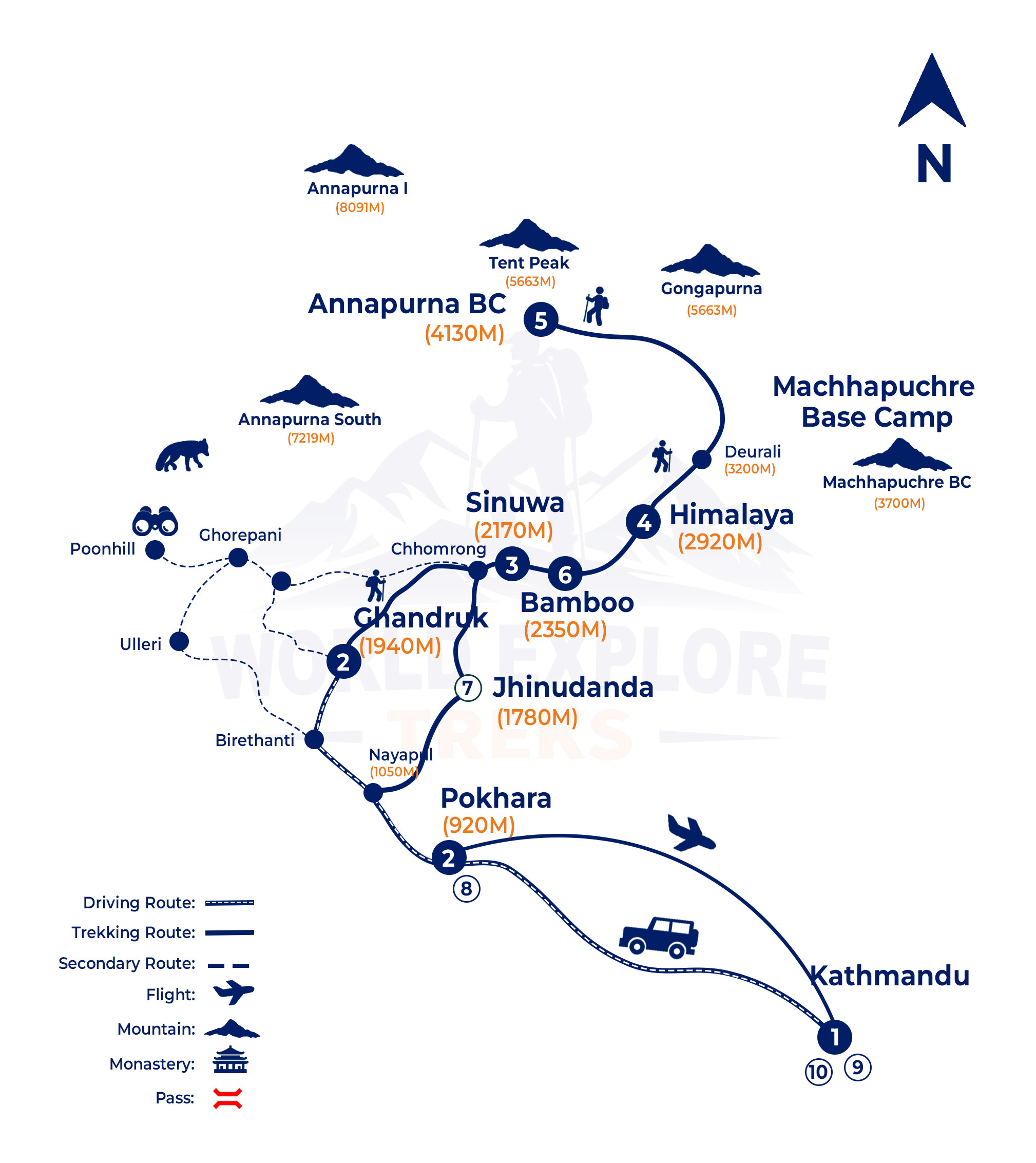
Route: Kathmandu → Pokhara → Kimrung Khola → Chhomrong → Lower Sinuwa → Bamboo → Himalaya → Deurali → Machhapuchhre Base Camp → Annapurna Base Camp → Bamboo → Chhomrong → Jhinu Danda → Pokhara → Kathmandu
The walking starts on Day 3 and reaches Annapurna Base Camp on Day 5. The way down is quicker, with a night at the Jhinu Danda hot springs before the drive back to Pokhara. Walking times are for an average trekker and include short breaks.
Day 5 is the hardest: about 1,200 m of climbing from Himalaya to base camp. Take it slowly, drink plenty of water and tell your guide about any headache or dizziness.
Trips Itinerary
Welcome to Nepal! Someone from our team will meet you at Tribhuvan International Airport and drive you to your hotel, about 20–30 minutes away. Take the afternoon to rest and get your bearings.
Later you meet your guide, who goes through the route, checks your boots, rain gear and warm layers, and collects your passport details for the ACAP permit and TIMS card. If anything is missing, the shops in Thamel sell or rent almost every piece of trekking gear.
Get an early night. The tourist bus to Pokhara usually leaves by about 8 am and takes most of the day.
Duration:
20–30 minute airport transfer
Accommodation:
Hotel in Kathmandu
Max Altitude:
1,400 m / 4,593 ft (Kathmandu)
The road west follows the Trishuli River for much of the way, past terraced hills, river gorges and roadside towns where buses stop for tea and dal bhat. Pokhara is about 200 km from Kathmandu, and the tourist bus usually takes 7–10 hours, depending on the road and traffic. If you’d rather fly, the flight takes about 30 minutes at extra cost.
Pokhara sits at 822 m beside Phewa Lake, which covers about 5.7 square kilometres. On a clear evening the peaks of the Annapurna range, including the sharp tip of Machhapuchhre, show above the hills and reflect in the water. A small two-storey pagoda temple, Tal Barahi, stands on an island in the lake.
Walk along the lakeside, have dinner and pack for the trek. Leave anything you won’t need on the trail at the hotel.
Duration:
7–10 hours by tourist bus (about 200 km)
Accommodation:
Hotel in Pokhara
Max Altitude:
1,400 m / 4,593 ft (Kathmandu)
Meals:
Breakfast
An early shared jeep takes you out of Pokhara and up into the hills. The road gets rougher and narrower as it climbs, and the 3–4 hour ride ends at Kimrung Khola, where the walking starts.
The trail climbs through farmland and forest to Chhomrong (2,170 m), a large Gurung village built on a steep hillside. From here Annapurna South (7,219 m), first climbed by a Japanese team in 1964, and the Fishtail peak of Machhapuchhre fill the view to the north.
Below the village a long stone staircase drops to the Chhomrong Khola, and after the bridge the path climbs again to Lower Sinuwa. You enter the Annapurna Conservation Area today, Nepal’s largest protected area at 7,629 square kilometres. Expect 3–4 hours of walking and a lot of steps.
Duration:
3–4 hours by shared jeep, then 3–4 hours walking
Accommodation:
Teahouse in Lower Sinuwa
Max Altitude:
2,340 m / 7,677 ft (Lower Sinuwa)
Meals:
Breakfast, lunch, dinner
The trail heads deep into the Modi Khola valley. It climbs through oak and rhododendron forest above Sinuwa, then drops down long stone steps to Bamboo (2,310 m), named after the thick bamboo groves along the river. Langur monkeys are often seen in the trees here.
After lunch at Dovan, the path climbs steadily beside the river, crossing side streams and passing small waterfalls. The valley walls get steeper and closer, and by early afternoon the sun disappears behind them.
Himalaya, also called Himalaya Hotel, is a small group of lodges at 2,920 m. It’s cooler and damper than the villages lower down, so put on a warm layer as soon as you arrive.
Duration:
5–6 hours
Accommodation:
Teahouse in Himalaya
Max Altitude:
2,920 m / 9,580 ft (Himalaya)
Meals:
Breakfast, lunch, dinner
The big climb of the trek, about 1,200 m, so you start early. The trail passes Hinku Cave, a large overhanging rock once used as a shelter, and reaches Deurali (3,230 m) in about two hours. From Deurali to base camp is roughly 7.7 km and 4–5 hours of steady walking.
Above Deurali the trees fall away and the valley opens. The path follows the Modi Khola past waterfalls and old avalanche debris to Machhapuchhre Base Camp (3,700 m), right below the twin-tipped summit that gives the mountain its Fishtail name. Local people consider Machhapuchhre sacred, and it’s closed to climbers.
The last climb to Annapurna Base Camp (4,130 m) is slow and breathless. When you arrive, you’re inside the Annapurna Sanctuary, a high bowl almost completely ringed by peaks, with Annapurna I (8,091 m), the first 8,000 m peak ever climbed, straight ahead. After heavy snow, the stretch between Deurali and Machhapuchhre Base Camp can be hit by avalanches, and your guide won’t continue if it isn’t safe.
Duration:
6–7 hours
Accommodation:
Teahouse at Annapurna Base Camp
Max Altitude:
4,130 m / 13,550 ft (Annapurna Base Camp)
Meals:
Breakfast, lunch, dinner
Get up before sunrise and wrap up warm. The first light hits the top of Annapurna I, then works its way around the ring of peaks, from Annapurna South and Hiunchuli, which is really a spur of Annapurna South, to Gangapurna, while the camp below is still in deep shadow and frost covers the ground.
After breakfast you head back down the valley, past Machhapuchhre Base Camp, Deurali and Himalaya, to Bamboo. It’s a long downhill day of 6–7 hours, and your knees will notice the stone steps, so use your poles and take your time.
As you lose height, the air gets thicker and warmer, and the forest closes in again around you.
Duration:
6–7 hours
Accommodation:
Teahouse in Bamboo
Max Altitude:
4,130 m / 13,550 ft (Annapurna Base Camp)
Meals:
Breakfast, lunch, dinner
The day starts with a climb back up the stone steps out of Bamboo, then the trail drops past Sinuwa to the Chhomrong Khola. From the bridge comes the hardest part: the long staircase back up to Chhomrong, which most people take slowly, with plenty of stops.
After lunch in Chhomrong, with a last look back up the valley at Annapurna South and Machhapuchhre, the trail drops steeply to Jhinu Danda (1,780 m).
In the afternoon, walk about 20 minutes down to the natural hot springs beside the Modi Khola. The pools are simple and open to the sky, and the warm water feels very good on tired legs after five days of walking.
Duration:
5–6 hours
Accommodation:
Teahouse in Jhinu Danda
Max Altitude:
2,340 m / 7,677 ft (Sinuwa)
Meals:
Breakfast, lunch, dinner
If you like, go back for one more soak in the morning. Then a short walk down the valley brings you to the road, where a shared jeep takes you back to Pokhara in about 2.5–3 hours.
The afternoon is free. Hire a boat on Phewa Lake, row out to the island temple, or just enjoy a long hot shower and a meal by the water.
Duration:
1–2 hours walking, then 2.5–3 hours by shared jeep
Accommodation:
Hotel in Pokhara
Max Altitude:
1,780 m / 5,840 ft (Jhinu Danda)
Meals:
Breakfast, lunch
In the morning a tourist bus takes you back to Kathmandu along the same road, which can use up most of the day if the traffic is heavy. You should be in by late afternoon, with time to freshen up.
In the evening, join us for a farewell dinner to celebrate the end of your trek.
Duration:
7–10 hours by tourist bus (about 200 km)
Accommodation:
Hotel in Kathmandu
Max Altitude:
1,400 m / 4,593 ft (Kathmandu)
Meals:
Breakfast, farewell dinner
Your trip ends today. Our driver collects you after breakfast and drops you at Tribhuvan International Airport in good time for your flight.
If you have more time, ask us about a jungle safari in Chitwan, a day tour of Kathmandu’s old temples, or a short trek to Poon Hill.
Max Altitude:
1,400 m / 4,593 ft (Kathmandu)
Meals:
Breakfast
Trips Include
The price covers your transport, permits, guide, porters, hotels and trail meals from arrival to departure. Personal costs and insurance are extra.
- Airport pick-up and drop-off by private vehicle
- 2 nights in a hotel in Kathmandu with breakfast (twin sharing)
- 2 nights in a hotel in Pokhara with breakfast (twin sharing)
- Kathmandu to Pokhara and back by tourist bus
- Shared jeep from Pokhara to Kimrung Khola, and from the end of the trail back to Pokhara
- 5 nights in teahouse lodges during the trek (twin sharing where available)
- Three meals a day during the trek (breakfast, lunch and dinner), with tea or coffee
- Experienced, government-licensed, English-speaking trekking guide trained in first aid
- Porter service: one porter for every two trekkers, carrying up to 10 kg per trekker
- Salaries, meals, accommodation, insurance and transport for your guide and porters
- Annapurna Conservation Area Permit (ACAP)
- TIMS card
- Down jacket, sleeping bag and duffel bag for the trek (to be returned afterwards)
- First-aid kit and pulse oximeter, carried by your guide for daily oxygen checks
- Trekking map and trip completion certificate
- Farewell dinner in Kathmandu
- Emergency rescue arrangements (paid for by your travel insurance)
- All government taxes, VAT and company service charges
Trips Exclude
- International flights to and from Kathmandu
- Nepal visa fee (visas on arrival are available for most nationalities)
- Travel insurance covering trekking up to 4,500 m and emergency helicopter rescue (mandatory)
- Lunch and dinner in Kathmandu and Pokhara, except the farewell dinner
- Flights between Kathmandu and Pokhara, if you'd rather fly
- Extra nights in Kathmandu or Pokhara caused by early arrival, late departure or an early return from the trek
- Personal expenses such as hot showers, battery charging, Wi-Fi, laundry and hot spring entry
- Bottled or boiled water, soft drinks, alcohol, snacks and extra hot drinks
- Personal trekking clothing and equipment
- Sightseeing and entry fees in Kathmandu and Pokhara, including boating on Phewa Lake
- Tips for your guide, porters and driver
- Anything not listed under Cost Includes
Trips Altitude
Trips Map
Good to Know
Days start early, around 6:30, because cloud often fills the Modi Khola valley by midday. You stop for lunch at a lodge on the way and usually reach the night’s teahouse by early afternoon, with time to rest and dry your clothes.
Dinner is around 6:30 in the warm dining room, and by 8:30 most trekkers are in their sleeping bags.
Lower villages like Jhinu Danda and Chhomrong are warm by day in spring and autumn, often T-shirt weather. Past Deurali the air cools quickly, and nights at Annapurna Base Camp are below freezing for much of the year.
Mornings are usually the clearest time. Afternoons can bring cloud, and sometimes rain or snow higher up.
This trek has a lot of stone steps, especially around Chhomrong and between Sinuwa and Bamboo. Going up is tiring, and coming down is hard on the knees.
Trekking poles help a lot. Take short steps on the way down and don’t rush. There’s no prize for getting to the lodge first.
Treat all tap and stream water, or buy boiled water from the lodges. Please don’t buy plastic bottles, as there’s no easy way to get them back down the valley.
Above Chhomrong, meat is rarely served because local people treat the Sanctuary as holy. The vegetarian food is good, and it’s the safest choice at altitude anyway.
Expect shared toilets, often squat-style higher up, so carry toilet paper and hand sanitizer. Hot showers cost a little extra and are often solar-heated, so they’re warmest in the afternoon.
At Jhinu Danda, the hot springs are about a 20-minute walk below the village. Bring a swimsuit and a small towel. The changing facilities are basic.
Your porter carries your duffel bag, up to 10 kg per person, and you carry a daypack with water, snacks, a warm layer and a rain jacket. Leave everything you won’t need on the trek at your hotel in Pokhara.
The villages on this trek are mostly Gurung. Dress modestly, ask before taking photos of people, and keep your voice down near shrines. The Sanctuary is a sacred place to local people, so treat it with care.
Carry out your rubbish, including wrappers and batteries. Stay on the trail, especially in the forest and around the base camps, and don’t pick rhododendron flowers. Please don’t give sweets or money to children.
Trips FAQs
It’s a moderate trek. You walk 5–7 hours on most days, and there are a lot of stone steps, especially around Chhomrong. Day 5 is the toughest, with about 1,200 m of climbing to base camp. You don’t need climbing skills, but you’ll enjoy it much more if you’re fit.
No. Any healthy person who walks regularly can do it. We suggest 4–6 weeks of training before you come: hiking, stair climbing, running or cycling, plus a few long walks with a loaded daypack.
Spring (March–May) and autumn (late September–November) are best. Spring brings rhododendron flowers to the forests, and autumn has the clearest mountain views. Winter (December–February) is cold, with snow above Deurali. In the monsoon (June–August), expect rain, cloud, leeches and the chance of landslides.
Base camp is at 4,130 m (13,550 ft). Altitude sickness can affect anyone above about 2,500 m, fit or not. Signs include headache, nausea, dizziness and poor sleep. We walk at a steady pace, and your guide checks your oxygen level every day with a pulse oximeter (a small clip on your finger). If symptoms get worse, the answer is to go down, and we arrange that straight away.
You need two: the Annapurna Conservation Area Permit (ACAP) and a TIMS card. For most foreign visitors, the ACAP permit costs NPR 3,000 and the TIMS card NPR 2,000. Both are included in this package and we get them for you. Just bring your passport and two photos.
Yes. Since April 2023, foreign trekkers in the Annapurna region must walk with a licensed guide and book through a registered trekking agency. This package includes an experienced, licensed guide.
Mainly in winter and early spring after heavy snow, on the stretch between Deurali and Machhapuchhre Base Camp. Lodges and guides watch the conditions closely, and the trail is closed when it isn’t safe. Your guide won’t cross that section if there’s any doubt.
You stay in teahouses: simple, family-run lodges with twin rooms, beds, blankets and a warm dining room. Toilets are often shared, and hot showers cost a little extra. In the busiest months, lodges at base camp fill up and you may have to share a room with more people. Bedrooms aren’t heated, so a good sleeping bag matters.
Teahouses serve Nepali, Tibetan and Western food: dal bhat (rice and lentils, usually with free refills), noodles, pasta, momos, soups, porridge and pancakes. Meat is rarely served above Chhomrong, out of respect for the local belief that the Sanctuary is a holy place.
Most lodges have Wi-Fi and charging for a small fee, and the price goes up as you climb. Mobile signal comes and goes. A local SIM card bought in Kathmandu or Pokhara is the cheapest way to stay in touch. Bring a power bank.
Your meals and rooms on the trek are covered, so budget around USD 15–25 a day for extras such as hot showers, Wi-Fi, charging, drinks and snacks. Bring cash in Nepali rupees from Pokhara, because cards are rarely accepted on the trail. Keep some aside for tips.
Yes. The flight takes about 30 minutes and saves a long day on the road. It costs extra, so ask us when you book.
Yes, it’s required. Your policy must cover trekking up to 4,500 m, emergency helicopter rescue and medical treatment. Cover for trip cancellation is a good idea too.
Yes. Popular add-ons are the Poon Hill sunrise viewpoint, an extra night at base camp, or a few more days in Pokhara. Tell us your dates and we’ll plan it with you.
Tipping isn’t required, but it’s normal and appreciated. Many trekkers give about 8–10% of the trip cost, shared between the guide and porters at the end of the trek.
Trips Reviews
No reviews found.